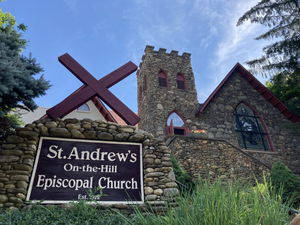
4 Epiphany, Yr A (2026) The Rev. Karen C. Barfield
4 Epiphany, Yr A (2026) The Rev. Karen C. Barfield
Micah 6:1-8 St. Andrew’s Episcopal Church
1 Corinthians 1:18-31
Matthew 5:1-12
In the name of the one, holy, and loving God:
in whom we live, and move, and have our being. Amen.
This week I read a blog post by Lutheran pastor, Nadia Bolz-Weber.
A woman named Kathryn had written her:
“Dear Nadia, I am struggling with the world’s weight.
I know it’s not mine alone to carry,
but every bit of bummer-news is like an assault on my heart.
How can I serve the world when the world’s condition is so heavy?”
I think many of us are in the same boat!
We are struggling with the weight of the world.
How can we serve
when surrounded
and weighed down
with such overwhelming need?
I have folks calling me or dropping by the church every week,
and the needs are great:
heating oil to stay warm in single digit temperatures,
car insurance to transport children,
security deposits for rent,
food, electricity, gas…you name it!
It seems to me that often the cultural world,
and the spiritual world,
bump up against each other,
providing moments of great friction, reflection, decision, and course of action.
Oftentimes, there are vast differences of opinion on how to solve all our problems.
In today’s Old Testament passage,
the prophet Micah is bewailing the fact
that God’s people are acting as if they don’t need God anymore.
So, God reminds them that God has delivered them from slavery into freedom…
a fact that they seem to have forgotten.
In response to this remembrance and their repentance,
the question arises: What can we do to appease God?
What things can we offer God?
Burnt-offerings?
Calves?
Thousands of rams?
Tens of thousands of rivers of oil?
My firstborn child?
No, God says.
No “thing” do I want.
What God requires is justice, mercy, and walking humbly with God.
God requires an embodiment of life that entails:
acting justly,
offering mercy,
and walking humbly with God.
If we root ourselves first and foremost in God,
then we will treat our neighbors with mercy and equity.
This is our starting point!
We root ourselves in God.
We wrap ourselves in God’s love and mercy
so that we may offer that to others…
as a starting place to offer healing to the world around us.
Paul, in his letter to the Christians at Corinth,
also shares with us some words of wisdom and encouragement,
even if they are challenging words to hear.
Paul says that the cross is foolishness to those who are perishing,
but to those who are being healed,
it is the power of God.
In worldly standards, the cross was an instrument of shame and violence.
By Jesus’ standards,
the cross was an instrument of love and humility…
a counter to the cultural violence of “an eye for an eye.”
Mercy is the currency of power in the Kingdom of God.
This is what Jesus has been teaching to his disciples.
This is what Jesus teaches us!
According to Jesus, a “blessed” life,
a Holy life, in the Kindom of God…
…is a life that acknowledges and reflects our dependence upon God alone…
a life in which those who feel loss are consoled by God’s presence…
a life for those who live into what they have, not seeking more…
According to Jesus, a holy life is…
…a life that exhibits mercy towards others, not judgment…
a life that tries to resolve differences peacefully, not with violence…
a life in which we stand up for God’s justice, equity, grace, and forgiveness for all
despite the fact that we may be persecuted for it.
So, when we find ourselves struggling with the weight of the world,
what do we do?
Nadia Bolz-Weber answers this question with a grand reminder:
None of us can carry it all!
Yet each of us can carry a bit.
That means that we each don’t have to carry the whole load!
We each just pick up one small thing.
And together, we can do more of the heavy lifting.
So…I wonder:
What small piece of this heavy world fits into our hand?
How are we called to love fiercely right where we are?
For some of us that may mean attending a rally
or writing our national, State, or local legislators.
For some of us it may mean cooking and serving a meal
or packing bags of food for local school children.
For some of us it may mean being with a friend or loved one
who is hurting or feeling alone or needs a ride.
For all of us,
we can pray.
We can root ourselves in God’s love and mercy
and extend that to others… even folks we disagree with,
or perhaps especially with folks we disagree with!
We can resist descending into despair
because we are all in this together.
We can call on each other when we are looking for hope.
We can’t heal the whole world,
but we can do our part in this little corner.
And if everyone does their little part,
then, just perhaps, we will begin to see God’s Light shining more brightly.
Let us keep the faith, my friends,
trusting in God’s love and mercy to flow through us
to help heal God’s broken and hurting people.
Amen.