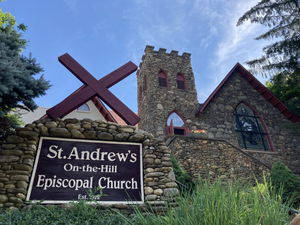
4 Lent, Yr A (2026) The Rev. Karen C. Barfield
4 Lent, Year A (2026) The Rev. Karen C. Barfield
John 9:1-41 St. Andrew’s Episcopal Church
In the name of the one, holy, and loving God:
in whom we live, and move, and have our being. Amen.
We find Jesus this morning,
having just ducked out of the temple,
narrowly escaping a stoning by some angry Jews
who have taken offense at his claim to be the Son of Man.
They have just had a lengthy conversation about sin…
and doing the will of God.
Jesus, in no uncertain terms,
has just said that whoever keeps his word will never taste death…
and that this particular group of Jews would not be included in that category.
As they pick up their stones to throw at him,
he ducks through the portico just in the nick of time.
As Jesus walks through the city streets of Jerusalem,
he sees a man who has been blind from birth.
The disciples,
who were presumably in the Temple with him,
listening to the conversation about sin,
ask him this question:
“Rabbi, who sinned,
this man or his parents,
that he was born blind?”
You see, it was presumed in that day
that if someone were afflicted with an illness or poverty
or any set of poor circumstance,
then either that person or their parents had sinned.
So…
either this man or his parents had been condemned as sinners from his very birth.
He never had a hope.
But Jesus rejects the notion that either this man or his parents had sinned.
Instead, he sees here an occasion to celebrate the glory of God.
_____________________________________
I want, for a few moments, to focus on this blind man….
a man considered guilty from birth of an unknown sin,
a man whose life was robbed from him from his first gasp of air,
a man destined to beg for a living before he could even walk.
We don’t know what this unnamed, silent man was doing when Jesus saw him.
Likely he was begging some money for food.
Perhaps he was sitting down in the road.
It would be tiring to stand all day long.
When Jesus saw him sitting there,
Jesus “spat on the ground and made mud with the saliva
and spread the mud on the man’s eyes.”
Now, imagine for a moment that you are completely blind.
You cannot see a thing around you.
And someone comes up and touches you.
How would you react?
I would at least flinch,
pulling myself backwards,
out of the way.
But what if when you were touched,
someone were spreading sticky, thick mud on your eyes?
I think my arms would come up swinging.
But not this blind man.
He remains in place.
Jesus, as he puts the mud on his eyes, says, “Go, wash in the pool of Siloam.”
And the silent man goes and washes and comes back… able to see.
What a remarkable response!
Being blind since birth,
this man has had many years navigating the city on his own.
But still…
he must make some effort
to go and find the city’s water reservoir in order to wash.
Does he even have a clue that it was Jesus who put mud on his eyes?
After all, he can’t see him!
Perhaps he’s heard Jesus teach before
and has heard of his miracles of healing.
Perhaps Jesus’ voice is etched into his brain
so that when he hears that first word “Go,”
a little glimmer of hope for his own healing is kindled.
Perhaps he’s in such desperate need of healing,
it doesn’t matter who it is.
___________________________________
When the blind man comes back seeing,
all the neighbors and folks who used to pass by him as he begged in the street
can’t believe their eyes.
“Is this not the man who used to sit and beg?”
They are all still talking about him,
but this time they are not discussing their usual conjectures
of what sin he committed.
They are asking questions about his identity –
who is he?
“I am the man,” he says.
His first words in our story.
He claims who he is.
“How were your eyes opened?”
“The man called Jesus….”
So, he did know who it was!
When he says that it was Jesus who opened his eyes,
they bring the man to the Pharisees,
the Jewish leaders in charge of interpreting and keeping the Law.
Remember that commandment:
“Remember the Sabbath and keep it holy”?
Well, the Pharisees considered making mud an act of work.
And by the blind man’s report,
Jesus had made mud on the Sabbath and spread it on his eyes.
Jesus, therefore, had not observed the Sabbath law.
He must be a sinner,
but how could a sinner perform such signs?
So they ask the man who was blind, “Who is he?”
“He is a prophet.”
___________________________________
Still not believing that his man had really been blind and healed,
the Jews call in his parents and ask them.
Yes, he was blind,
and now he sees.
Not wanting to be thrown out of the synagogue themselves,
the parents send the Pharisees back to the man to learn how he gained his sight.
The Pharisees call the man back for the second time,
and this time he really lays into them.
“Here is an astonishing thing!” he says.
Do you not get it?
Do you not see?!
“You don’t know where he comes from,
and yet he has opened my eyes.
“We know that God listens to those who do God’s will.
“If this man were not from God,
he could do nothing.”
Exasperated and indignant, the Pharisees respond,
“You were born entirely in sins,
and are you trying to teach us?”
And they drove him out.
They drove him out.
Just as they drove Jesus out of the temple.
From birth his community had bound this man in sin.
His inquisitors now try to keep him bound,
de-legitimizing his healing by condemning Jesus.
Have you noticed that in this entire story,
no one rejoices with this man,
not even his parents?
A man blind since birth can see for the first time,
and no one celebrates his gift of Grace.
____________________________________
When Jesus hears that they had driven him out,
he comes to find this man.
“Do you believe in the Son of Man?”
“And who is he, sir?
Tell me, so that I may believe in him.”
[Remember that at this point,
the man born blind has never seen Jesus with his eyes.
Jesus put mud on his eyes and told him to go and wash,
but when the man returned with his sight, Jesus was gone.]
“You have seen him,” Jesus says,
“and the one speaking with you is he.”
“Lord, I believe.”
_____________________________________
Throughout this story the sight of the man born blind becomes clearer and clearer.
He begins in silence - mute.
He then calls Jesus a man.
He next reveals him as a prophet
and finally the Son of Man!
As I reflected on this story,
some questions arose for me in my own life –
perhaps for you, too.
An unexpected Grace visited this man born blind,
and he accepted it…
What times in my life has God’s Grace visited me and I refused to accept it
because it showed up in a new or unexpected way?
What times in my life have I witnessed God’s Grace in someone else’s life
and not rejoiced with them?
Are there times when I have received a glimmer of hope which blossomed into a healing that I never could have imagined - just because I took one step forward in faith?
I invite us all this week to carry the story of this man born blind with us,
that we may let God’s Grace unbind us
in whatever form or fashion it may show up…
so that we, too, may boldly proclaim:
Lord, I believe!
Amen.