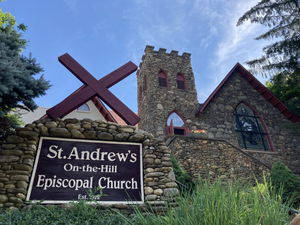
6 Easter, Yr A (2026) The Rev. Karen C. Barfield
6 Easter, Yr A (2026) The Rev. Karen C. Barfield
Acts 17:22-31 St. Andrew’s Episcopal Church
1 Peter 3:13-22
John 14:15-21
In the name of the one, holy, and loving God:
in whom we live, and move, and have our being. Amen.
This morning we find Paul on his 2nd missionary journey,
having gained some new followers of Jesus
and having gained some folks who want to kill him!
So, his disciples whisk him down the coast to Athens,
a cosmopolitan city where just about anything goes.
As Paul walks around the city,
he sees many idols and is greatly disturbed.
However, when he finds himself in front of the Areopagus,
speaking to philosophers and perhaps some Roman leaders,
he begins by finding common ground.
“Athenians,” Paul says, “I see how extremely religious you are in every way.
For as I went through the city and looked carefully at the objects of your worship,
I found among them an altar with the inscription, ‘To an unknown god.’”
Paul then continues to proclaim that this “unknown God”
is, in fact, the Creator of heaven and earth…
creator of every creature and all humankind.
This God, Paul says, created humankind so that we would search for God…
and perhaps reach out and find God.
This God, Paul says,
is not very far from each and every one of us.
In fact, it is in this God that we live, and move, and have our being!
As I was reflecting on this text,
I was struck by the reference to an altar with the inscription,
“To an unknown god.”
The presence of such an altar with an inscription to an unknown god
speaks of a people who possess a degree of humility,
a people who are open to some degree of mystery.
To construct such an altar with this inscription
means that the people were open to the possibility that they didn’t know everything,
and/or that there is a deepness, wideness, and unknowable mystery to God.
How refreshing!
And, I suggest that Paul sees this openness and humility.
Paul sees this people searching for the depths of a God who is very near…
the God in whom we all live and move and have our being.
This week I just finished reading a new book by Stephanie Spellers, an Episcopal priest.
The book is entitled:
Church Tommorow? What the ‘Nones’ and ‘Dones’ teach us about the Future of Faith.
Given the decline of the mainline Protestant denominations,
she was interested in learning why Americans are leaving religious institutions
and moving toward a different kind of spiritual journey.
During the Winter of 2025 she interviewed Nones and Dones, ages 18-44.
She asked the following questions:
1. Share about your spiritual journey and what path led you to where you are now.
2. How and where do you experience the sacred?
3. How and where do you experience community and belonging?
4. What would you tell the church/organized religion if it were listening?
Now, her book is 223 pages long and contains many nuances,
so I won’t cover them all this morning!
However, if anyone wants to read her book and discuss it, let me know.
One thing she discovered is that,
despite the decline in church attendance,
she believes that Americans still hold some belief in the divine and spirituality.
“Secularization may be at work,
but we are not a secular nation.” (pg. 18)
She says, “people may be opting out of organized religion,
but they’re not leaving God behind.” (ibid.)
We are not leaving God behind.
Perhaps that is because God is not far from each one of us.
In God we live and move and have our being.
Spellers speaks of the isolation,
the fear for the future of the earth,
and the loneliness that young people experience.
She speaks of their longing for community, love, welcome, and belonging.
I suggest that longing is true for people of all ages!
It is true for us!
At our annual meeting, when asked what people valued about St. Andrew’s,
the frequent response was: the community and love.
Part of a loving community is the sense of welcome and belonging.
In today’s gospel reading,
Jesus is gathered with his community of disciples on the evening of what we call,
“The Last Supper.”
Jesus is preparing the disciples for his departure…
“If you love me,
you will keep my commandments.”
Those commandments are, of course, to love God and love neighbor.
To ease their pain at his loss,
he promises that God will send another Advocate to them,
so that they will not be alone.
They will not need to search and grope for God,
for God will abide within them.
Jesus says to the disciples, “You know [the Spirit of truth, the Advocate, the paraclete]
because [the Spirit] abides with you,
and [the Spirit] will be in you.
The word for “Advocate” is “paracletos,” meaning “to come alongside another.”
Jesus was the first paraclete,
coming alongside us in the incarnation to reveal to us the invisible God.
But, even though Jesus must go away,
he asks the Father to send another Advocate “to be with [us] forever.”
Forever.
We will not be left alone!
We will be bound to God and to one another in the Spirit of love…
in community…
in a place and space of belonging.
And others will come to know God
because the disciples keep Jesus’ commandments to love one another.
God’s love is not only true
but is the source of Life itself.
In the words of James Finley and Mirabai Starr with Michael Petrow,
“Love is our origin,
love is our ground,
love is our sustaining reality,
and love is our destiny.
“Love and love alone is the substance of reality.
Everything else is smoke and mirrors, really.”
[James Finley and Mirabai Starr with Michael Petrow, “The Song of Love Lost and Found,” The Living School: Essentials of Engaged Contemplation, Center for Action and Contemplation, 2025.]
So… what is our mission as disciples of Jesus?
Our mission is to be the Body of Christ in the world.
If God abides in us,
then God’s love abides in us,
and it is this love that we are to share with the world.
It means that we are to become “paracletes”….
We are to become those who come alongside another.
We come alongside those who are searching and reaching out for God…
we come alongside those who are struggling and lost in pain…
we come alongside those who are lost and alone and cannot find their way.
We are humble.
We are curious.
We are love.
As we come alongside another…
and as we allow another to come alongside us…
we are united in the community of God’s Spirit,
making incarnate God’s love for the whole world.
Amen.