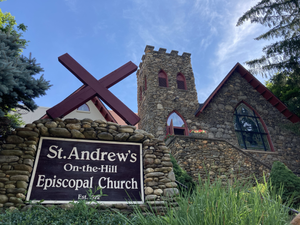
Proper 28, Yr A (2026) The Rev. Karen C. Barfield
Psalm 90:1-12 St. Andrew’s Episcopal Church
1 Thessalonians 5:1-11
Matthew 25:14-30
In the name of the one, holy, and loving God:
Creator, Redeemer, and Sanctifying Spirit. Amen.
This morning we once again hear readings about living in the in-between times.
Today’s Psalmist speaks of the span of our life as 70 years…
“perhaps in strength even eighty.”
I must say this congregation pushes well beyond that
although some of you may question the word “strength!”
The last line of today’s reading says,
“teach us to number our days
that we may apply our hearts to wisdom.”
I suggest that is a prayer request to pay attention to each day of our lives
so that we may live out our wisdom.
In Paul’s letter to the Thessalonians, he urges the church community
to live with awareness…
in faith, hope, and love
while encouraging and building up each other.
These are the ways to live in this in-between time.
This week’s meditations from the Center for Action and Contemplation have the theme of:
“What is mine to do?”
What is mine to do?
In other words…
How do we each engage the wisdom we have gleaned over the years?
How do we each share our abundant resources: our time, our money, our talents?
How do we live with the well-being of others at the forefront of our consideration?
On Monday I read a reflection written by Randy Woodley,
a theologian and co-founder of the Eloheh Indigenous Center for Earth Justice,
on his unique call in service to others.
It really expanded my frame of thinking…
and hopefully, of living.
I want to share it with you.
He says,
“Every spring, my wife Edith and I kneel in the dirt of our ten-acre farm
in Oregon’s Willamette Valley and do something that looks,
to the untrained eye,
like nothing much.
“We plant seeds.
“Some of them are varieties that Indigenous peoples have been keeping alive
for hundreds, maybe even thousands of years –
“seeds passed from hand to hand across generations,
carried through removals and relocations,
hidden in pockets during forced marches,
saved when everything else was taken.
“We put them in the ground,
we water them,
and we wait.
“It doesn’t look like revolution.
“It doesn’t look like resistance.
“It looks like two people with dirt under their fingernails
doing small work
in a world full of enormous problems.
“But after decades of this work,
I’ve learned sometimes the most radical thing you can do
is plant something you’ll never see fully grown….
“What is ours to do?
“It’s whatever is right in front of us,
done with full attention and love,
connected to the web of relationships that sustains everything.
“For some people that means running for office or organizing their neighbors.
“For others, it means tutoring a child or cooking for the elders.
“For Edith and me, it means keeping seeds alive
and welcoming whoever shows up at the farm.
“And here’s what I want to say to anyone paralyzed by the enormity of what’s wrong:
“You don’t have to fix everything.
You just have to be faithful to your particular piece. [repeat]
“My ancestors understood this.
“Not everyone was a medicine person.
Not everyone was a warrior or chief.
“Some people made baskets.
Some people told stories.
Some people tended fires.
“The community needed all of it,
and nobody’s gift was less sacred than anyone else’s.
“Indigenous people traditionally made major decisions
with the seventh generation in mind.
“That’s roughly 175 years into the future.
“Think about that for a moment.
“I’ve planted oaks that I will never see fully mature.
“When you plant a seed,
thinking about people who won’t be born for another century and a half,
it changes your relationship to time,
to despair,
and to what counts as success.
“I will not see most of what I’m planting for.
“That’s fine.
“That’s the work.
“The people who for generations saved the seeds we plant at Eloheh
didn’t save seeds for themselves.
“They saved seeds for us –
through removals,
through boarding schools,
through every attempt to erase them.
“And we save seeds for people we’ll never meet.
“That’s what is ours to do.
“Not to solve everything,
but to plant faithfully.
“Not to despair at the harvest we won’t see,
but to trust that the seeds are good,
the soil is alive,
and the Creator is still at work in the dirt and the mess of it all.”
[Randy Woodley, “Planting for the Seventh Generation: What is Ours to Do?” Oneing 14, What is Ours to Do? (CAC Publishing, 2026): 99-100, 103-104.]
One day this past Spring when I visited Nancy Rice,
she gave me some plant starts…a couple of different kinds of beans.
One kind was Cherokee “Trail of Tears” black beans.
I have never grown beans before,
but I planted them in the soil in our backyard.
I watered them…
and waited.
The beans grew,
and I waited until they dried to harvest them
so that we could eat them this Winter.
I have no idea how many generations of people handed down those beans.
I am grateful to have received them…
and to carry on growing them for years to come.
Many things struck me about Randy’s reflection.
One that really caught my attention
is making major decisions with the seventh generation in mind.
That means to live with intention
and to live,
knowing that what I do will affect people I cannot even yet imagine!
A few weeks ago in our congregational listening sessions,
several of the core values that people named the most were:
Faith, community, service, hope, and love.
I invite us to consider the question:
What is ours to do?
How do we encourage each other
and build up each other
so that we may live in faith, hope, and love…
How do we offer ourselves and our resources and our wisdom
to build up the kindom of God for generations we’ll never know?
It is a question worth asking each day…
and then to respond daily as we meet the needs we find along the way.
Amen.