Trinity Sunday, Yr A (2026) The Rev. Karen C. Barfield
Trinity Sunday, Year A (2026) The Rev. Karen C. Barfield
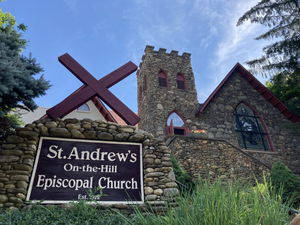
Genesis 1:1-2:4a St. Andrew’s Episcopal Church
Matthew 28:16-20
In the name of the one, holy, and loving God:
Creator, Redeemer and Sanctifying Spirit. Amen.
Today is the only Sunday in the church year devoted to a church doctrine.
I could ramble on for 10 or 15 minutes,
trying to get at something that took well over a century
to hammer out in our Creed,
but this morning I really want to address this question:
What difference does belief in a Trinitarian God make in our lives?
Is there room for doubt or even unbelief?
Let’s take a look at the Gospel….
Tom Long, retired preaching professor at Candler School of Theology,
points out that we find Jesus on an unnamed mountain in backwater Galilee,
with a congregation of 11… down from 12,
and even some of these 11 are doubting and not so sure why they are here.
They come and worship Jesus but aren’t quite sure why. (from Feasting on the Word, Yr A, Vol 3, p. 47)
Now, mind you…
these are folks who have traveled day by day with Jesus for several years running
and have personally witnessed his healing people from disease,
casting out demons,
and even raising the dead!
They witnessed his crucifixion,
and saw evidence of his resurrection.
He has now just spent time with them again:
opening up the Scriptures,
breaking bread with them and continuing to teach them…
AND YET THEY STILL DOUBT!
They still doubt,
yet despite their doubt
they continue to worship him.
Now, part of being disciples is being students
who watch and learn and reflect,
and practice our learning and ask questions,
and make mistakes and then begin again….
watching and learning,
reflecting and asking questions,
practicing and making mistakes.
In our baptisms,
we believe that we are immersed into the whole Being of God,
whether we understand all that that means or not!
It is because we are intimately connected with the Trinity
that we are able to be disciples.
Let’s take a look at the Trinity upside-down:
The Holy Spirit makes it possible for us
to recognize and believe the good news of God the Son,
who reveals to us the loving heart of God the Father.
We have been created out of and through the love of the Father –
in the very image of God!
We have been redeemed by Grace
through the life and death and resurrection of the Son.
We live in love through the communion of the Holy Spirit…
with the Father and the Son.
St. Athanasius believed that unity within God
is a unity of love
in which the identity of each party is not swallowed up and annihilated
but established.
If we live within this Trinitarian unity,
then our own identities are established in God!
The fullness of who we are exists in God.
So, you see,
our view of God does affect how we live our lives.
If we believe,
even if only upon occasion,
that we are created, restored, and made holy in and through the love of God,
then why would we not want to go share this good news with others?
Jesus commissions his disciples saying,
“All authority in heaven and on earth has been given to me.
Go therefore and make disciples of all nations…”
The disciples are sent to do what Jesus has been doing…
baptizing and healing and teaching
and with more far-reaching effect… to all nations.
It is through their relationship to Jesus
and through his relationship to the triune God
that they would access the power to teach, proclaim, and heal.
Jesus’ Good News of the kindom is not simply information to be rehearsed
but a living out of Jesus’ love and compassion and mercy in the world.
The content of the teaching is one piece,
but the example of the living most likely has far greater impact!
Making disciples of all the “nations” doesn’t mean “nation-states”
but “tribes of people who are not at all like you.”
The fact that this task is so overwhelming
means that the disciples must rely upon God’s mercy and strength.
The work of the Church cannot be taken up unless it is true that “all authority” does not belong to the church and her resources (our resources) but to God.
God is the source of all that we are and all that we have.
And, Jesus says, he is with us always,
even to the end of the age.
So, my friends, we are equipped and sustained by God
to share God’s love with the whole world!
So, what difference does it make in our daily lives
that we believe in a Trinitarian God?
It means that if we are created, renewed, and sustained by the Spirit of God
then we can take a fragmentary community,
a fragmentary faith,
a fragmentary understanding of the Trinitarian God
and go into the world with everything Jesus has taught us.
We need not eradicate doubt in order to live faithfully.
We live as we are:
with a mixture of faith and doubt,
hope and fear,
success and failure…
all before the throne of God.
Our goal is not to fill the pews or pad the offering plate –
our goal is to embody Christ in the world –
sharing in word and deed with everyone we meet
God’s radical love.
Amen.