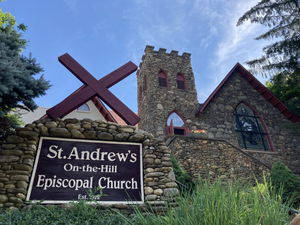
Proper 18, Yr A (2026) The Rev. Karen C. Barfield
Proper 18, Yr A (2026) The Rev. Karen C. Barfield
Romans 13:8-14 St. Andrew’s Episcopal Church
Matthew 18:15-20
In the name of the one, holy, and loving God:
in whom we live, and move, and have our being. Amen.
In these days and times,
the more news I read or hear,
the more overwhelmed I feel
with the suffering and pain and senseless violence in the world.
And, in the news, at least,
language is often disrespectful and demeaning…
Which leads me to wonder what is our role as Christians…
What is my role as one who claims to follow Jesus?
This past Thursday in a post entitled:
“Becoming Disciples: Full of Suffering, Full of Love,”
Richard Rohr commented:
“Christians are called to be the visible compassion of God on earth.”
“Christians are called to be the visible compassion of God on earth.”
Or, as Paul says to the Church at Rome:
“Owe no one anything,
except to love one another….”
Well, that seems simple and straight forward.
Although as we all know,
to truly love is neither simple
nor straight forward!
Paul gives us a little help when he says that
“love does no wrong to a neighbor.”
If we act in love,
then we do no harm.
And I’d suggest this includes the whole of creation, not just humankind.
“Owe no one anything,
except to love one another.”
If we extend the understanding of love to embodying compassion…
that means that in our love, not only do we “do no harm,”
but we also suffer alongside all of God’s creation that is suffering.
Compassion…
suffering with.
The late Archbishop Desmond Tutu and his daughter, Mpho Tutu,
wrote a book entitled, The Book of Forgiving:
The Fourfold Path for Healing Ourselves and Our World.
In the introduction they say,
“In our own ways, we are all broken.
“Out of that brokenness, we hurt others.
“Forgiveness is the journey we take toward healing the broken parts.
“It is how we become whole again.” (p. 3)
“The quality of human life on our planet is nothing more than the sum total
of our daily interactions with one another….
“Because we are human,
some of our interactions will go wrong,
and then we will hurt or be hurt, or both….
“Forgiveness is the way we set those interactions right.
It is the way we mend tears in the social fabric.
It is the way we stop our human community from unraveling.” (p. 4)
“For every injustice, there is a choice….
You can choose forgiveness or revenge,
but revenge is always costly….
“Peace always comes to those who choose to forgive.” (p. 7)
“In South Africa, Ubuntu is our way of making sense of the world.
“The word literally means ‘humanity.’
“It is the philosophy and belief that a person is only a person through other people.
“In other words,
we are human only in relation to other humans.
“Our humanity is bound up in one another,
and any tear in the fabric of connection between us
must be repaired for us all to be made whole.
“This interconnectedness is the very root of who we are.” (p. 8)
In Matthew’s gospel Jesus gives instructions as to how to repair the tears
in the fabric of our connections.
“If another member of the community harms you,
go and point out the fault when the two of you are alone….”
Desmond and Mpho also speak to the ways to make repair…
the ways to love our neighbors when we do wrong or are wronged.
There are several key ingredients to repair:
telling the story,
naming the harm,
listening,
and granting forgiveness.
Jesus says,
“whatever you bind on earth will be bound in heaven,
and whatever you loose on earth will be loosed in heaven.”
How we live our lives in relationship to one another has cosmic consequences.
Now, I will say right now…
I don’t have any grand answers for us today…
just some thoughts and questions for reflection.
How do we…
you and I,
love our neighbors as ourselves?
How do we live as one…
walking alongside those people, creatures, or elements who suffer…
including ourselves…
and offer a true story,
a listening heart,
and forgiveness?
How do we embody God’s loving compassion,
grace,
forgiveness,
and new life?
It takes an enormous amount of courage and vulnerability
to tell another that they have caused you harm.
Sometimes they may not even be aware of it.
But, Jesus says, it is necessary to restore the community and the bonds of love…
to restore right relationship.
Jesus’ entire goal is to restore the community…
to reconcile the community…
to teach and encourage the community to live in the way of love…
a way that considers and respects the dignity and wellbeing of every person.
And he says that what we do here and now has cosmic effects:
“whatever you bind on earth will be bound in heaven,
and whatever you loose on earth will be loosed in heaven.”
What we do and how we live in relation to one another affects everyone:
ourselves and everyone else in our communities,
whether or not they are a participant in the actual conflict itself.
Think about that:
If we harbor hurt, anger, and resentment,
then everyone around us is affected by these things:
ourselves, our family and friends, our colleagues, our neighbors.
The way of love…
the way of reconciliation…
the way of naming a harm as we tell our story
and then live into forgiveness…
this is how we “loose” people on earth – and in heaven.
And, Jesus says, do this in person!
Email or text or a letter or another messenger do not work.
Harm is personal
and needs a personal confrontation…
in humility and love.
The Good News is that Love is always available from God.
God seeks out the one who has gone astray in order to bring them back.
God seeks us out when we wander off the path of love
and rejoices when we return home.
And, according to our scriptures, this is to be our way, too.
As God loves us,
we are to love others.
We are to seek out the one who has wandered off the path of love,
to speak our story and to listen to theirs…
to offer grace and mercy and forgiveness to others as God does to us.
“Owe no one anything,
except to love one another…
Love does no wrong to a neighbor.”
May we learn to so love…
with God’s Grace.
Amen.