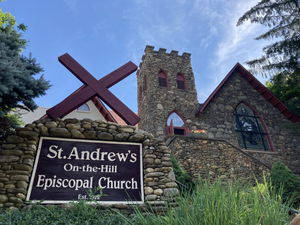
Proper 19, Yr A (2026) The Rev. Karen C. Barfield
Proper 19, Yr A (2026) The Rev. Karen C. Barfield
Genesis 50:15-21 St. Andrew’s Episcopal Church
Psalm 103:(1-7), 8-13
Romans 14:1-12
Matthew 18:21-35
In the name of the one, holy, and loving God:
in whom we live, and move, and have our being. Amen.
This morning I begin with a story related by Archbishop Desmond Tutu in his work with the Truth and Reconciliation Commission in South Africa:
“‘He had many wounds.’
“She spoke with the precision of a coroner.
‘In the upper abdomen were five wounds.
These wounds indicated that different weapons were used to stab him,
or a group of people stabbed him.’
“Mrs. Mhlawuli continued her harrowing testimony
to the Truth and Reconciliation Commission.
“She spoke about the disappearance and murder of her husband, Sicelo.
‘In the lower part, he also had wounds.
In total, there were forty-three.
They poured acid on his face.
They chopped off his right hand just below the wrist.
I don’t know what they did with that hand.’
[Tutu says,] “A wave of horror and nausea rose in me.
“Now it was nineteen-year-old Babalwa’s turn to speak.
“She was eight when her father died.
Her brother was only three.
“She described the grief,
police harassment,
and hardship in the years since her father’s death.
“And then she said,
‘I would love to know who killed my father.
So would my brother.’
“Her next words stunned me
and left me breathless.
‘We want to forgive them.’
‘We want to forgive,
but we don’t know who to forgive.’”
(from Desmond Tutu and Mpho Tutu, The Book of Forgiving: The Fourfold Path for Healing Ourselves and our World, pp. 1-2.)
It is a breathtaking story…
as breathtaking as the story of Joseph forgiving his brothers.
Joseph’s brothers had left him for dead at the bottom of a dry well.
Then they sat down to eat.
While they were eating,
they realized that Joseph’s dying at the bottom of a well
would not benefit them in any way other than having him out of the picture.
Meanwhile…
they spotted a group of Ishmaelites traveling with their goods to Egypt.
“Ah,” they devised,
“we can sell him to the Ishmaelites,
his blood will not be on our hands,
and we will make a profit.”
When the brothers went to enact their new plan,
they discovered that Joseph had disappeared.
So, they soaked his cloak in blood and presented it to their father,
who mistakenly assumed that Joseph had been killed by a wild animal.
And all because they were jealous.
Jealousy of Joseph’s dreams and his favor with their father
was the driver of such horror.
So, at the point of today’s story many years later,
after Jacob’s death and burial,
Joseph’s brothers huddle up and wonder if now the time of reckoning had come.
With Jacob, the peace-keeper, dead,
the brothers thought that perhaps Joseph would now give them their due
for the harm they did to him.
So they come up with another story…another lie…
They approached Joseph, saying,
“Your father gave this instruction before he died,
‘Say to Joseph: I beg you, forgive the crime of your brothers
and the wrong they did in harming you.”
Jacob likely had not instructed them to say any such thing.
And I doubt that Joseph actually believed their story.
And yet…
he forgave them.
Joseph forgave them for leaving him in a well to die.
He forgave them for their jealousy and fear and deceit.
He just forgave them.
It is a breath-taking story.
Radical forgiveness is breath-taking!
And God forgives us all the time.
In today’s gospel story Peter… dear Peter,…
always trying to get things right, asks Jesus,
“Lord, if another member of the church sins against me,
how often should I forgive?
If you recall in last week’s gospel story,
Jesus talks about how to reconcile with a member of the community
who has done you harm.
Jesus says that our binding and loosing has effects not only here and now…
but cosmic effects as well.
Jesus’ goal was reconciliation.
So, following on that story Peter says, “Ok, Jesus, I hear you.
But, just tell me this:
how many times do I have to forgive someone?
As many as seven times?”
And Jesus says to him,
“Not seven times, but, I tell you,
seventy-seven times.”
Or, some translators say “seventy times seven,” or 490 times!
In other words, there is no limit to forgiveness!
That is a hard pill to swallow,
especially at the hand of great harm,
but I will say that given my six decades of life, I agree with Jesus!
Forgiveness is difficult,
but to not forgive is death.
To not forgive will destroy the perpetrator,
the victim,
and everyone associated with them…
even the cosmos, Jesus says.
Some years ago Richard Rohr offered a meditation on restorative justice.
He said,
“We all need to apologize,
and we all need to forgive,
for humanity to have a sustainable future.
“Otherwise, we are controlled by the past, individually and corporately.
“History easily devolves into taking sides,
bitterness,
holding grudges,
and the violence that inevitably follows.
“No wonder that almost two-thirds of Jesus’ teaching
is directly or indirectly about forgiveness.
“As others have said,
‘Forgiveness is to let go of our hope for a different past.’
“Reality is what it is,
and such acceptance leads to great freedom,
and the possibility of healing forgiveness.”
(Rohr, in meditation through the Center for Action and Contemplation, 2020)
Joseph’s brothers came to him and said,
“Now therefore
please forgive the crime of the servants of the God of your father.”
Joseph wept when they spoke to him.
Then his brothers also wept.
Joseph said to them,
‘Do not be afraid.
Am I in the place of God?...
Have no fear; I myself will provide for you and your little ones.”
It is a breathtaking story.
Forgiveness, in any form,
is breathtaking.
And forgiveness is what God calls us to do to heal and restore ourselves,
one another,
our communities,
and the world.
Given the tremendous difficulty to forgive,
especially for harmful and destructive actions,
Desmond Tutu points out that sometimes we aren’t yet ready to forgive.
At those times, he suggests,
we pray for God to make us willing to forgive.
“Lord, help me want to forgive.”
It is a good suggestion.
Jesus tells us to pray for our enemies.
That is another way to soften our hearts to prepare for forgiveness.
“Forgive us our sins
as we forgive those who sin against us,”
we pray in The Lord’s Prayer.
As we forgive ourselves and others,
we extend the wideness of God’s mercy,
and what is broken has room to heal.
Tutu also says that sometimes, even with forgiveness,
the harm is so great that the relationship must be let go.
Other times the relationship will move forward in a renewed way.
Either way, we are enabled to live into God’s radical way of love and mercy,
freeing ourselves in the midst of forgiving another.
In the words of today’s Psalmist:
1 Bless the Holy One, O my soul, *
and all that is within me, bless God’s holy Name.
2 Bless the Holy One, O my soul, *
and forget not all the gifts of God.
3 O God, you forgive all our sins *
and you heal all our infirmities;
4 You redeem our life from the grave *
and crown us with mercy and loving-kindness;
5 You satisfy us with good things, *
and our youth is renewed like an eagle’s.
6 O God, you execute righteousness *
and judgment for all who are oppressed.
7 You made your ways known to Moses *
and your works to the children of Israel.
8 You are full of compassion and mercy, *
slow to anger and of great kindness.
9 You will not always accuse us, *
nor will you keep your anger for ever.
10 You have not dealt with us according to our sins, *
nor rewarded us according to our wickedness.
11 For as the heavens are high above the earth, *
so is your mercy great upon those who fear you.
12 As far as the east is from the west, *
so far have you removed our sins from us.
13 As a parent cares for a child, *
so do you care for those who fear you.
Amen.