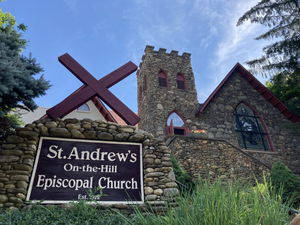
Proper 6, Yr A (2026) The Rev. Karen C. Barfield
Proper 6, Yr A (2026) The Rev. Karen C. Barfield
Exodus 19:2-8a St. Andrew’s Episcopal Church
Matthew 9:35-10:23
In the name of the one, holy, and loving God:
in whom we live, and move, and have our being. Amen.
The accounting of names is always important.
Names are the ways that we identify ourselves
and one another.
“What names are you considering?” we ask new parents when he hear of a pregnancy.
The lack of names is also important.
Often in our Gospels we hear a story of an unnamed person…
usually it is a person living on the margins of society:
unnoticed and unnamed.
And, oftentimes,
Jesus proclaims that is these folks who have the greatest faith.
The Gospel According to Matthew begins this way:
“An account of the genealogy of Jesus the Messiah,
the son of David,
the son of Abraham.
“Abraham was the father of Isaac,
and Isaac the father of Jacob,
and Jacob the father of Judah and his brothers,
and Judah the father of Perez and Zerah by Tamar and on and on until we hear:
“and Jacob the father of Joseph, the husband of Mary,
of whom Jesus was born,
who is called the Messiah.” (Mt 1:1-16)
The accounting of names
is important.
In today’s gospel reading Jesus calls the twelve apostles by name:
“Simon…and his brother Andrew;
James…and his brother John;
Philip and Bartholomew;
Thomas and Matthew the tax collector;
James and Thaddaeus;
Simon the Cananaean and Judas Iscariot.” (Mt 10:2-4)
The accounting of names is important
because to name someone is to claim them -
to claim relationship with them -
as we do with family, colleagues, and friends.
To name someone is to give them power, respect, dignity, authenticity.
We acknowledge who they are.
We see them as people…
as children of God.
Today’s gospel reading tells us that Jesus went about all the cities and villages teaching,
proclaiming the good news of the kindom,
and curing every disease and sickness.
When he saw the crowds he had compassion for them,
because they were harassed and helpless,
like sheep without a shepherd.
Jesus then summons the twelve disciples and sends them out, saying:
“proclaim the good news, ‘the kingdom of heaven has come near.’
Cure the sick,
raise the dead,
cleanse the lepers,
cast out demons.”
For these are signs of the healing and reconciling power of God.
Jesus calls the disciples,
those who were following in his footsteps…
and then sends them out as apostles (those who are sent)
to tend the needs of the many.
He sends out the apostles to share in his healing and reconciling ministry…
a ministry of claiming and restoring people.
The accounting of names is important.
Jesus called the twelve,
by name,
and told them to go and proclaim the good news:
“The kingdom of heaven has come near.”
Go first to your own people…
your own cities…
your own churches and neighborhoods…
and proclaim a word of love and mercy and forgiveness and justice.
But, Jesus gives the apostles a word of a reality check:
“I am sending you out like sheep into the midst of wolves.”
Not everyone is going to understand God’s kindom of respect and mercy and dignity…
not everyone is going to understand God’s kindom of name-claiming.
Jesus says that the people in power will take offense.
Be prepared.
The ones who stand and endure for justice…
the ones who claim every person as a beloved child of God in need of respect…
these ones will be persecuted by those in power.
Yet, God says, I am with you…
even to the end of the ages.
My friends,
just as the apostles were sent to proclaim the presence of God’s kindom,
we, too, are sent.
The Spirit of the risen Christ gives us the authority to heal the brokenness amongst us.
The Spirit will guide us and give us words to speak.
Jesus says to expect opposition and persecution.
Corrupt power does not let go without a fight.
Today’s reading from Exodus encourages us on our journey:
God reminds the Israelites that God freed them from bondage in Egypt
and brought them forth, through the wilderness, into new life.
Our journeys may sometimes feel unwelcome and foreign like the wilderness,
but God’s promise is that God is good
and that God will lead us into new life.
This is our calling.
We are sent out to invite others to partake of God’s offer of new life.
If we hear and obey God’s commands for justice and mercy and healing,
then we must notice, listen to, and stand with those who are harassed and need help.
God summons us to work in the fields.
The harvest is plentiful, Jesus says,
but the laborers are few.
There aren’t too many willing to go out and take a stand
for those who are abused or ignored or cast aside….
for those people whose names are never acknowledged.
The harvest is plentiful (people are searching for Good News),
and the work is hard and painful.
It is costly.
And yet the work is necessary and urgent!
As we are sent into the crowds,
the noise all around us can be overwhelming.
It is important to remember that in the midst of all the chaos and shouting in the world,
we must take time to find some silence…
so that we may listen for the voice of God.
We must take time to listen to the voice of others
and to the voice of God.
We are called to practice – as Jesus did –
the self-emptying,
radical nonviolence
of a vulnerable God.
God’s love and compassion will uphold and strengthen us.
As we find ourselves out in the harvest and see others in need,
let us not just walk on by,
but look upon each person with compassion.
“What is your name?” we may ask.
“What is your story?”
“What do you need?”
If we are to spread the Good News that the kindom of heaven has come near,
we are called to listen to the voices of those who are suffering.
That includes those of us gathered here.
And then we are called,
in compassion,
to stand alongside and suffer with our neighbors,
bringing forth healing and forgiveness and reconciliation for all.
God is with us…
every step of the journey.
Amen.