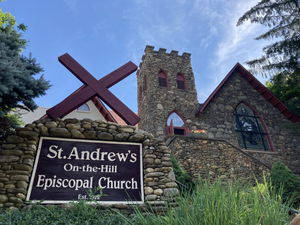
Proper 7, Yr A (2026) The Rev. Karen C. Barfield
Proper 7, Yr A (2026) The Rev. Karen C. Barfield
Romans 6:1b-11 St. Andrew’s Episcopal Church
Matthew 10:24-39
In the name of the one, holy, and loving God:
in whom we live, and move, and have our being. Amen.
As I was reading the texts for today, two things stood out for me:
“do not be afraid” and
“resurrection.”
Then as I was preparing what to say,
the Spirit led me to the writings of several theologians…
from the Middle Ages to contemporary times.
On Easter Sunday this year, Richard Rohr wrote of how the resurrection offers hope,
especially in challenging times.
I think it is safe to say that we are all experiencing challenging times!
Rohr says,
“I often wonder why so much of human life seems so futile,
so tragic,
so short,
and so sad.
“If Christ is risen,
why do people die before they begin to truly live?
“Why has there been nonstop war?
Why are so many people imprisoned unjustly?
Why are the poor oppressed?
Why do we destroy so many of our relationships?
“If Christ is risen,
why is there so much suffering?
“What is God up to?
“It really doesn’t make any logical sense.
Is the resurrection something that just happened once, in his body, but not in ours?
“I believe the resurrection of Christ is saying
that the final judgment has already happened.
“It’s nothing we need to fear.
It’s nothing we need to avoid or deny.
“God’s final judgment is that God will have the last word!
“Easter reveals that there are no dead ends;
ultimately, nothing is going to end in tragedy and crucifixion.
“Of course, we look around us,
at history and at life in its daily moments and it seems,
‘No, that isn’t true.’
“And yet, ever and again,
here and there, more than we expect,
new life breaks through for those who are willing to see and to cooperate
with this universal mystery of resurrection.”
Rohr then tells the story of stepping outside to watch the Easter sunrise:
“The sun rose as it always does and peeked over the horizon,
just between two mountains.
“It appeared not so much like a sunrise
but as a groundswell.
“The light was coming from the earth.
“It was coming from the world we live in.
It was coming not from the top,
but from the bottom.
“It seemed to say that even all of this,
which looks so muddy and material,
even all this,
which looks so ordinary and dying,
will be reborn.
“Easter is the feast of hope.
“This is the feast that says [that] God will have the last word
and that God’s final judgment is resurrection.
“God will turn all that we maim and destroy and hurt and punish
into life and beauty.
“What the resurrection reveals more than anything else is that
love is stronger than death.
“Jesus walks the way of death with love,
and what it becomes is not death but life….
this is the mystery: nothing dies forever…all that has died will be reborn in love.”
[taken from the mediation on April 5, 2026 from The Center for Action and Contemplation]
In Paul’s letter to the Romans,
he tells the fledgling church…and us…
that we are people of the resurrection!
In our baptisms “we have been buried with Jesus by baptism into death…
so that we too might walk in newness of life.
“For if we have been united with him in a death like his,
we will certainly be united with him in a resurrection like his.” (Ro 6:4-5)
Contemporary theologian Matthew Fox speaks of how we live into a life of resurrection:
“To be Resurrection for another I need to be Resurrection for myself.
“That means I cannot dwell in [despair] and death and anger
and oppression and submission
and resentment and pain forever.
“I need to wake up,
get up,
rise up,
put on life even when days are dark and my soul is down
and shadows surround me everywhere….
“I have to listen to the voice that says:
‘Be resurrection’….
‘Be born again. And again. And again.
“Rise up and be counted.
“Rise up and imbibe the good news deeply –
that death does not conquer,
that life, not death, has the last word….”
[Matthew Fox and Marc Andrus, Stations of the Cosmic Christ (Unity Village, MO: Unity Books, 2016), 138-139]
Be resurrection.
That can be difficult
when the world around us or the world within us feels dark.
But that is why we gather here together to remind each other
that God is with us…
that we are with each other…
and that life is more powerful than death.
In the words of Julian of Norwich:
“Beloved One, may you be blessed because it is so: all is well.” (Showings)
Mirabai Starr, spiritual teacher and translator, describes how Julian’s positive experience of God sustained her when things were not “well” in the world around her:
“The medieval English anchoress Julian of Norwich bequeathed us a radically optimistic theology.
“She had no problem admitting that human beings have a tendency to go astray.
“We rupture relationships,
dishonor the Divine,
make unfortunate choices,
and try to hide our faults.
“And yet, Julian insists,
‘All will be well and all will be well and every kind of thing shall be well.’”
[Julian of Norwich, The Showings: Uncovering the Face of the Feminine in Revelations of Divine Love, trans. Mirabai Starr (Hampton Roads, 2022), 67. Selection from chap. 27.]
Starr continues…
“This assertion is meant to penetrate the fog of our despair and wake us up.
“She does not simply state,
‘Everything’s going to be okay.’…
“She does not ask us to engage in a spiritual bypass by relegating everything that unfolds
to the will of God,
calling it perfect against all evidence to the contrary.
“She squarely faces the inevitability that we will miss the mark
and that there is wickedness in this world.
“Even so, she is convinced that the nature of the Divine is loving-kindness,
and she wants us to absorb this into every fiber of our being.
Julian couldn’t figure out why the all-powerful God
wouldn’t have just eliminated our negative proclivities, saying,
‘If he had left sin out of creation, it seems to me, all would be well.’
“But what God-the-Mother showed Julian in a near-death vision
was that all shall be well anyway….”
Starr continues…
“Julian unpacks this for us [in chapater 27].
In so doing she dispenses with the whole concept of sin and replaces it with love.
‘I believe that sin has no substance,’ Julian writes,
‘not a particle of being.’
“While sin itself has no existential value,
it has impact.
It causes pain.
It is the pain that has substance.
“But mercy is swiftly forthcoming.
It is immediately available.
“It is frankly rude of us to doubt that all will be well
(and all will be well and every kind of thing shall be well).
‘When he said these gentle words,’ Julian writes, speaking of God-the-Mother,
‘he showed me that he does not have one iota of blame for me,
or for any other person.
‘So, wouldn’t it be unkind of me to blame God for my transgressions
since he does not blame me?’
“The merciful nature of God renders the whole blame game obsolete….”
“Eventually we will awaken to the truth that we are unconditionally adored by God.”
[Mirabai Starr, Wild Mercy: Living the Fierce and Tender Wisdom of the Women Mystics (Sounds True, 2019), 175-177.]
We are all unconditionally adored by God.
My friends, God invites us to walk in newness of life,
setting aside our fears,
embracing God’s radical love and mercy for ourselves
and, in turn, offering such radical love and mercy to others.
Amen.